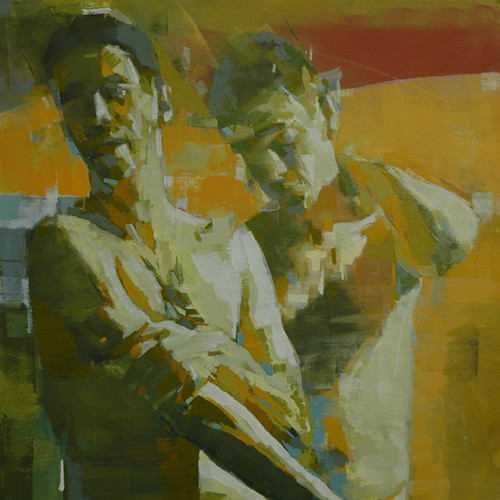
January 24, 2011

you walk out

"When you're in the studio painting, there are a lot of people in there with you - your teachers, friends, painters from history, critics... and one by one if you're really painting, they walk out. And if you're really painting YOU walk out." — Philip Guston

December 17, 2010

pitcher with pears

12" x 16", oil on canvas, 2010

November 24, 2010

Graham Nickson on Cezanne


"For Cezanne the tension of forms colliding in space is what the universe is about. He’s discovered how negative space puts pressure on the positive shape. Form and space is about the tension between forms. Think of it like a blueberry sitting in a bowl of yogurt. The yogurt holds the blueberry in place and because of the yogurt, it’s more volumetric." [from my notes at the NYSS Marathon, winter 2008]

November 22, 2010

JMJ no.4

November 9, 2010

forget everything

An account of Chardin's conversion:

"One of the first things he did was a rabbit. This object may seem of slight importance; but the manner in which he wanted to do it made it a serious study. He wanted to depict it with the greatest truthfulness in all respects, but at the same time tastefully, with no overtones of servitude that might make its execution dry and cold. 

He had never attempted to paint fur before. He realized that he should not paint it hair by hair, or reproduce it in detail. 'Here is an object which I must aim to reproduce', he said to himself. 'In order to concentrate on reproducing it faithfully I must forget everything I have seen, and even forget the way such objects have been treated by others. I must place it at such a distance that I cannot see the details. I must work at representing the general mass as accurately as possible, the shades and colors, the contours, the effects of light and shade.'"

from, "Chardin: The Unknowing Subversive?" by Pierre Rosenberg

November 1, 2010

October 29, 2010

the wrinkled old woman and some words from Robert Bly


“My main thought is that we, being so worldly, so informed, so flooded with motifs from the past, find it more and more difficult to allow any object, whether a snowstorm or a toad or a painting, to… reach the soul.

“The job of the writer [or the painter!] …is to give us a frog or a giant or a snowstorm and to protect it from all the invisible forces that want to delay it, elaborate it, relate it to correct opinions, prevent it from arriving at the soul…

…we recognize that Rembrandt is able to bring the wrinkled face of an old woman right up to our soul.”

Robert Bly from his introduction to “The Best American Poetry 1999”


October 21, 2010

brothers no. 3


brothers no. 3, originally uploaded by Mark Horst.

October 8, 2010

strategies for wrecking paintings no. 3

There are lots of ways to keep a painting from getting overly teachy. Mediocre painting tries to say too much, leaves no room for the eye to move. And so when I see the teacher getting the upper hand as a painting is developing I think about doing something bad.

Francis Bacon used to throw paint at his paintings, just to see how something completely accidental might improve things. I prefer painting outside the lines: letting the brush have some freedom, letting it dance around the canvas. That beautiful green on the door frame is also right up there next to an eye brow and there under the chin. Why not. Here's a painting where the brush did it's dance:


Here's a painting by Ann Gale--whose paintings remind me of the Swiss painter, Giacometti:

too much beauty

This week I've been soaking up a benediction from Mary Oliver:


When loneliness comes stalking, go onto the fields, consider
the orderliness of the world. Notice
something you have never noticed before,

like the tambourine sound of the snow-cricket
whose pale green body is no longer than your thumb.

Stare hard at the hummingbird, in the summer rain,
shaking the water-sparks from its wings.

Let grief be your sister, she will whether or no.
Rise up from the stump of sorrow, and be green also,
like the diligent leaves.

A lifetime isn’t long enough for the beauty of this world
and the responsibilities of your life.

Scatter your flowers over the graves, and walk away.
Be good-natured and untidy in your exuberance.

In the glare of your mind, be modest.
And beholden to what is tactile, and thrilling.

Live with the beetle and the wind.

Mary Oliver
excerpted from “flare"


I love the idea of being "green" like the "diligent leaves" and "untidy" in exuberance. Tidiness does take the edge off exuberance, doesn't it? 
But what really hits me here, right now, is the idea that:
"A lifetime isn’t long enough for the beauty of this world AND the responsibilities of your life." 
Life's responsibilities will muscle pretty much everything else out of their way--if you give them too much attention. I've done that for long enough.

Followers