November 1, 2010

October 29, 2010

the wrinkled old woman and some words from Robert Bly


“My main thought is that we, being so worldly, so informed, so flooded with motifs from the past, find it more and more difficult to allow any object, whether a snowstorm or a toad or a painting, to… reach the soul.

“The job of the writer [or the painter!] …is to give us a frog or a giant or a snowstorm and to protect it from all the invisible forces that want to delay it, elaborate it, relate it to correct opinions, prevent it from arriving at the soul…

…we recognize that Rembrandt is able to bring the wrinkled face of an old woman right up to our soul.”

Robert Bly from his introduction to “The Best American Poetry 1999”


October 21, 2010

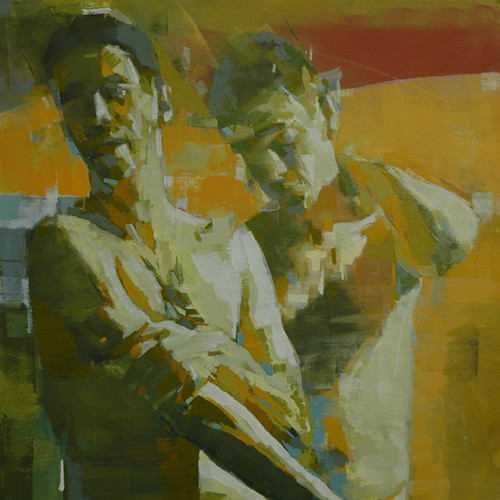
brothers no. 3


brothers no. 3, originally uploaded by Mark Horst.

October 8, 2010

strategies for wrecking paintings no. 3

There are lots of ways to keep a painting from getting overly teachy. Mediocre painting tries to say too much, leaves no room for the eye to move. And so when I see the teacher getting the upper hand as a painting is developing I think about doing something bad.

Francis Bacon used to throw paint at his paintings, just to see how something completely accidental might improve things. I prefer painting outside the lines: letting the brush have some freedom, letting it dance around the canvas. That beautiful green on the door frame is also right up there next to an eye brow and there under the chin. Why not. Here's a painting where the brush did it's dance:


Here's a painting by Ann Gale--whose paintings remind me of the Swiss painter, Giacometti:

too much beauty

This week I've been soaking up a benediction from Mary Oliver:


When loneliness comes stalking, go onto the fields, consider
the orderliness of the world. Notice
something you have never noticed before,

like the tambourine sound of the snow-cricket
whose pale green body is no longer than your thumb.

Stare hard at the hummingbird, in the summer rain,
shaking the water-sparks from its wings.

Let grief be your sister, she will whether or no.
Rise up from the stump of sorrow, and be green also,
like the diligent leaves.

A lifetime isn’t long enough for the beauty of this world
and the responsibilities of your life.

Scatter your flowers over the graves, and walk away.
Be good-natured and untidy in your exuberance.

In the glare of your mind, be modest.
And beholden to what is tactile, and thrilling.

Live with the beetle and the wind.

Mary Oliver
excerpted from “flare"


I love the idea of being "green" like the "diligent leaves" and "untidy" in exuberance. Tidiness does take the edge off exuberance, doesn't it? 
But what really hits me here, right now, is the idea that:
"A lifetime isn’t long enough for the beauty of this world AND the responsibilities of your life." 
Life's responsibilities will muscle pretty much everything else out of their way--if you give them too much attention. I've done that for long enough.

September 30, 2010

a great calamity

"It is surely a great calamity for a human being to have no obsessions."

September 14, 2010

September 11, 2010

strategies for wrecking paintings no. 2

Of course I don't really mean "wrecking" them. I mean what Susan Sontag refers to when she says that "scrofulous, tarnished, stained, cracked, faded [photographs] still look good; do often look better." I want the painted surface to reflect something of the experience of it's making--it's time. I want to subvert the illusion of representation even as I struggle with all my abilities to render an accurate, well measured and proportioned image.

So here's another way I wreck my paintings: I take a flexible rubber-like scraper and draw it through the painting to get unexpected and sometimes interesting patterns and blending of colors. I usually can't work up the nerve to do this until I've decided the painting is a complete and utter disaster. Then I can cut loose and scrape away. Here are two examples of that--the first a smaller 12" x 16" canvas and the second a larger 30" x 40" work:


September 10, 2010

strategies for wrecking paintings...

As a painter I have so many strategies for "tarnishing" the image on the canvas. I find nothing more tedious that a painting that leaves nothing for the eye to do. It's like a child pounding on the piano keys, as if getting all the notes were the only challenge to making music.

So I routinely wreck my paintings in order to save them from a worse fate. I spread turpentine on them, I scrape them, I rub them, I brush them--sometimes I throw things at them. They're almost always better as a result.

Here's one of my current favorite strategies which simply involves taking a dry brush and raking the wet paint. Gerhard Richter does this all the time and puts the results in the Museum of Modern Art.


Here's something from Richter:


people

"It is when people are at peace, content, full, that they are most likely to meet my expectation, selfish, no doubt, that they be a generous, joyous, even entertaining experience for me. I believe people exist to be enjoyed, much as a restful or engaging view might be. As the ocean or drifting clouds might be. Or as if they were the human equivalent of melons, mangoes or any other kind of attractive, seductive fruit.

When I am in the presence of other human beings I want to revel in their creative and intellectual fullness, their uninhibited social warmth. I want their precious human radiance to wrap me in light. I do not want fear or war or starvation or bodily mutilation to steal both my pleasure in them and their own birthright.

Everything I would like other people to be for me, I want to be for them."

Alice Walker

Followers